RCAF Centennial Project
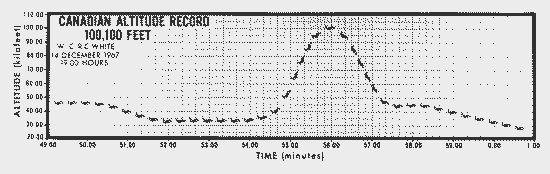
The Canadian Aircraft Altitude Record
A Canadian altitude record was established by the
RCAF with a CF-104 aircraft on 14 December
1967. The record was set by Wing Commander
R.A. White from the Aerospace Engineering
Test Establishment at the Canadian Forces
Base, Uplands, Ottawa. Twelve flights were
made near Shirley Bay and tracked by the
DRTE 30 foot precision tracking antenna,
designed by Northern Electric R&D
Laboratories, Ottawa. The flights occurred
in a test area beginning some 100 miles
west of Ottawa. A small beacon vas installed
in the nose of the aircraft operating on
a frequency of 4 GHz. The aircraft was
accurately tracked during the flight by
the 30-foot antenna using the received
beacon signal. Azimuth and elevation angles
from the antenna position readouts and
range to the aircraft from a pulse transponder
system were recorded by a computer at tenth
of a second intervals. From these data, with corrections for atmospheric
refraction, the altitude was calculated.
The aircraft achieved a level airspeed
of 1,800 MPH during the record flight which reached an altitude of
100,110 feet. This was a Canadian record. The world record is 113,892
feet achieved by a Russian MIG-21 using a rocket booster in 1961,
but International Aviation Federation rules no longer allow rocket
booster aid in establishing height records for jet aircraft. The exacting
series of measurements and authentication were made by J.W.B. Day,
K.S. McCormick and W.J. Pawziuk of DRTE. The attempt at a
record was part of the many special activities
of Centennial Year.
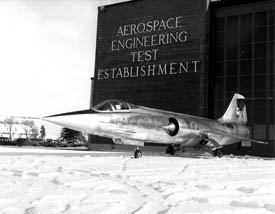
The CF-104 aircraft, tail number 12700, used by W/C Bud White to set a Canadian altitude record for a jet aircraft. This was a Centennial Project of the Aerospace Engineering Test Establishment which was located at RCAF Station Uplands in Ottawa. |
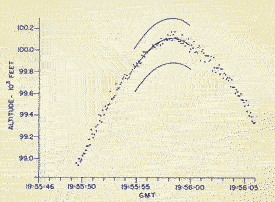
Plot of the altitude of Bud White's aircraft during his record-breaking flight. The measurements were made from the new Satellite Communications facility at Building 46. |
|
|
|